
Published Date: 14/06/2026
To Download the file of full volume of Conference Proceedings, click on following Link:
https://ijrmp.org/wp-content/uploads/2026/06/IJRMP-Special-Issue-June-2026.pdf
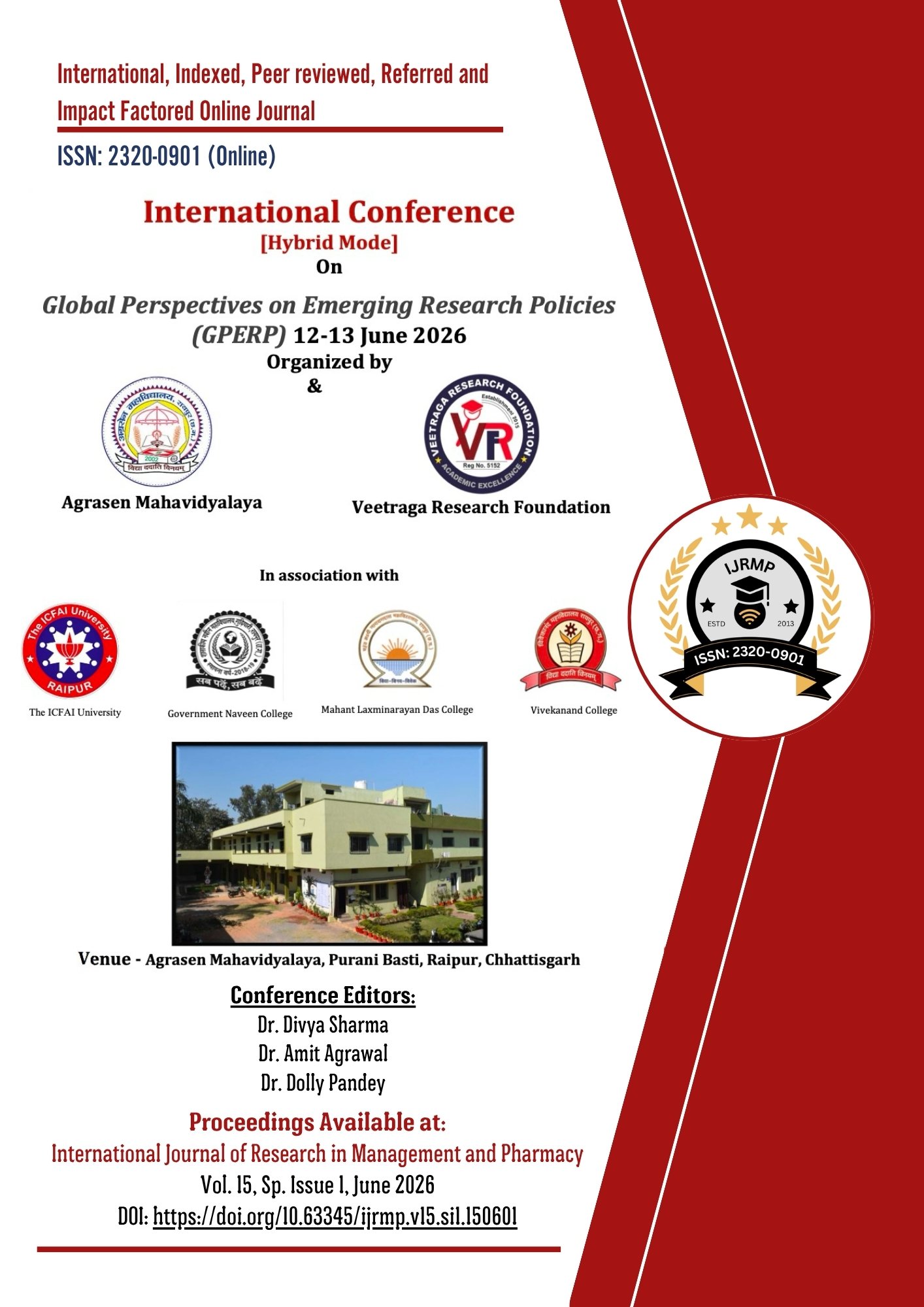
DOI: https://doi.org/10.63345/ijrmp.v15.si1.150601
| S. No. | Particulars | Author(s) | Page No. |
| 1 | Digital Research Competency and AI Readiness among Teacher Trainees: Implications for Emerging Research Policies | Dr. Divya Sharma | 1–8 |
| 2 | Role of Artificial Intelligence in Research Policy and Innovation: A Global Perspective on Emerging Research Policies | Bhawana Kshatriya, Rajnee Pagar | 9–12 |
| 3 | English as the Global Research Language: Barrier or Bridge to Inclusive Knowledge? | Potshangbam Sushma Devi; Dr. Vanitha C. | 13–16 |
| 4 | Localization Vs Globalization in Research Policy | Dr. Vatsala Tiwari | 17–20 |
| 5 | A Comparative Study of Migrant and Non-Migrant Labor Families in Baloda Bazar-Bhatapara District with Reference to Education, Health, and Social Security: Sociological Perspective | Dr. Ashok Kumar Dewangan | 21–27 |
| 6 | Inclusive Research Policies for Equity and Diversity | Bandana Soreng | 28–43 |
| 7 | Ethical Challenges, Academic Accountability, and Research Integrity in the Use of AI-Generated Content: A Data-Based Analytical Study | Dr. Manju Sahu | 44–48 |
| 8 | Intellectual Property Rights and Innovation Policies: An Indian Perspective | Dr. Neha Shukla | 49–55 |
| 9 | Global Perspective on Emerging Research Policies: Digital Transformation in Research and Higher Education | Ms. Swaleha Nisa | 56–62 |
| 10 | Global Research Policy in Transition: Emerging Trends, Tensions, and Transformations | Anija L | 63–69 |
| 11 | Impact of Digital Transformation on Research and Higher Education | Dr. Kusum Chandrakar | 70–73 |
| 12 | From Household Wisdom To Financial Awareness Among Working Women: Indigenous Knowledge System and Women | Dr. Shantanu Paul; Ms. Anjali Majumdar | 74–79 |
| 13 | A Study on Implementation of NEP-2020 and Institutional Transformation | Dr. Gurpreet Kaur | 80–84 |
| 14 | Reimagining Pedagogy through AI-Integrated Indian Knowledge Systems under NEP 2020 Framework | Dr. Rakhi Sharma | 85–92 |
| 15 | Designing Value-Based AI Curriculum: Integrating Ethical Intelligence with Academic Learning Outcomes | Dr. Vijai Kumar Gupta | 93–100 |
| 16 | A Study on the Role of Artificial Intelligence in Personalized Learning Pathways among Secondary School Students | Dr. Shiv Lal Yadav | 101–108 |
| 17 | Digital Well-being and Screen-Time Management among School Students: Educational Implications | Prof. (Dr.) Dharmendra Shukla | 109–115 |
| 18 | Cooperative Learning Method on Innovative Achievement Emotions, ICT Competency, Social Skills, and Academic Performance in Biology | Jyoti Kumari | 116–125 |
| 19 | The Use of Digital Tools in Teacher Education: An Analytical Study of ICT Integration and Its Impact on the Performance of Secondary School Students | Rashmi Narayan; Dr. Rana Jairam Singh | 126–134 |
| 20 | Transformative Teacher Education in the AI Era: Bridging Indigenous Pedagogy and Digital Competency | Dr. Santosh Garg | 135–143 |
| 21 | Integrating Artificial Intelligence with Indigenous Scientific Knowledge Systems for Sustainable Innovation and Environmental Solutions | Maheshwari | 144–149 |
| 22 | Digital Research Competency among Teacher Educators | Pitambar Kumar Sahu | 150–158 |
| 23 | Regulating Artificial Intelligence in Education: A Legal Analysis of Data Protection, Accountability, and Ethical Governance in India | Prerna Tiwari Pandey | 159–165 |
| 24 | माध्यमिक विद्यालयीन शिक्षकों के कार्यस्थलीय तनाव, कार्यसंतुष्टि एवं व्यावसायिक प्रतिबद्धता के मध्य संबंध का अध्ययन | बबीता मधुकर; डॉ. पुष्पा शर्मा | 166–176 |
| 25 | युवाओं में रोजगारपरक कौशल विकसित कर उनके आर्थिक विकास को बढ़ावा देने में वैश्विक शोध नीतियों की भूमिका | डॉ. युलेन्द्र कुमार राजपूत; एकता ठाकुर | 177–179 |
| 26 | शोध नैतिकता : सिद्धांत, चुनौतियाँ और समकालीन परिप्रेक्ष्य | डॉ. मंजू सिंह ठाकुर | 180–185 |
| 27 | NEP 2020 के परिप्रेक्ष्य में शिक्षा एवं सामाजिक समानता का समाजशास्त्रीय विश्लेषण | डॉ. उषा लहरे | 186–195 |
| 28 | अनुसंधान में स्थानीकरण बनाम वैश्वीकरण | डॉ. पूजा दुबे | 196–199 |
| 29 | लघु वनोपज के डिजिटलीकरण एवं ई-मार्केटिंग में वैश्विक शोध नीतियों की भूमिका | डॉ. युलेंद्र कुमार राजपूत; ओंकार प्रसाद साहू | 200–205 |
| 30 | डिजिटल भुगतान पद्धतियों के बढ़ते उपयोग का नकद व्यवहार पर प्रभाव का अध्ययन | डॉ. अमित कुमार अग्रवाल; श्री अंशु दत्ता | 206–218 |
| 31 | कृत्रिम बुद्धिमत्ता आधारित वैयक्तिकृत अधिगम और विद्यार्थियों के समग्र विकास पर उसका प्रभाव | सचिन द्विवेदी | 219–228 |
| 32 | कृत्रिम बुद्धिमत्ता आधारित पोषण विश्लेषण प्रणालियों का पारंपरिक भारतीय आहार पद्धतियों के संदर्भ में अध्ययन | डॉ. रिनी गुप्ता | 229–238 |
| 33 | भारतीय ज्ञान परंपरा के आलोक में मूल्य-आधारित शिक्षा और डिजिटल शिक्षण का समन्वय | डॉ. विद्या प्रकाश सिंह | 239–247 |
| 34 | राष्ट्रीय शिक्षा नीति 2020 के संदर्भ में भारतीय ज्ञान परंपरा का पुनर्संयोजन: एक विश्लेषणात्मक अध्ययन | डॉ. शिव प्रकाश; दिव्या चौधरी | 248–257 |
| 35 | डिजिटल अधिगम प्लेटफॉर्म का विद्यार्थियों की शैक्षणिक उपलब्धि एवं सहभागिता पर प्रभाव | संजू कुमारी | 258–267 |
| 36 | पारिवारिक वातावरण के मनोवैज्ञानिक आयामों का विद्यार्थियों की अभिप्रेरणा एवं शैक्षणिक सफलता पर प्रभाव | अमन सिंह; डॉ. चंचला देवी सिंह | 268–275 |
| 37 | माध्यमिक स्तर के विद्यार्थियों के व्यक्तित्व कारक का तुलनात्मक अध्ययन: प्रयागराज जनपद के विशेष संदर्भ में | समर बहादुर यादव | 276–284 |
| 38 | कृत्रिम बुद्धिमत्ता और शिक्षक प्रशिक्षण कार्यक्रमों में नवाचार: एक समालोचनात्मक अध्ययन | डॉ. सीमा गुप्ता | 285–296 |
| 39 | प्रेमचंद के कथा साहित्य में स्त्रियों की सामाजिक स्थिति एवं उनके आत्म-विकास की संभावनाएँ: एक शैक्षिक दृष्टिकोण | अर्चना पांडेय | 297–305 |
| 40 | AI आधारित व्यक्तिगत अधिगम और विद्यार्थियों के आत्म-नियंत्रित अधिगम व्यवहार का विश्लेषण | डॉ. अजीत शुक्ला | 306–312 |
| 41 | डिजिटल अधिगम प्लेटफॉर्म का विद्यार्थियों की शैक्षणिक उपलब्धि एवं सहभागिता पर प्रभाव | डॉ. ओंकार नाथ शर्मा | 313–319 |
| 42 | भारतीय सांस्कृतिक मूल्यों के अध्ययन में कृत्रिम बुद्धिमत्ता की भूमिका | डॉ. संतोष कुमार सुमन | 320–327 |
| 43 | समग्र शिक्षा कार्यक्रम एवं भारतीय सांस्कृतिक मूल्यों का बालिका शिक्षा पर प्रभाव: रांची जिला के संदर्भ में | कंचन कुमारी | 328–336 |
| 44 | डिजिटल अधिगम वातावरण में विद्यार्थियों की अभिप्रेरणा एवं सीखने के व्यवहार का तुलनात्मक विश्लेषण | डॉ. शिव प्रकाश; दिव्या चौधरी | 337–343 |
| 45 | प्रेमचंद की कहानियों में सामाजिक न्याय की अवधारणा और समावेशी शिक्षा के संदर्भ में उसका विश्लेषण | कमलेश कुमार पाल | 344–353 |
| 46 | झारखण्ड के राँची जिले के दिव्यांगों की सामाजिक-आर्थिक स्थिति के सुधार में सरकारी एवं गैर-सरकारी संस्थाओं की पहल | डॉ. सलमा खातून; रंजू कुमारी | 354–362 |
| 47 | भारतीय ज्ञान परंपरा के परिप्रेक्ष्य में कृत्रिम बुद्धिमत्ता आधारित शिक्षण का हिंदी भाषा अधिगम पर प्रभाव: एक विश्लेषणात्मक अध्ययन | डॉ. निर्मला परगनिहा | 363–378 |
| 48 | विद्यालय इंटर्नशिप कार्यक्रम एवं छात्राध्यापकों के शिक्षण कौशल का अंतर्संबंध: डी.एल.एड. प्रशिक्षणार्थियों के संदर्भ में एक अध्ययन | डेकेश्वर प्रसाद वर्मा; प्रो. (डॉ.) अभिषेक श्रीवास्तव | 363–378 |
| 49 | Innovation Policies and Brand Protection in LIC of India: A Study of Institutional Transformation in India’s Insurance Sector | Ms. Surbhi Pandey | 379–393 |
| 50 | Challenges and Opportunities in MSME Research Ecosystem: Evidence from Tribal Dominated Regions of Chhattisgarh | Ayush Notwani; Dr. Kirti Shrivas | 394–401 |
| 51 | उभरती शोध नीतियां, स्वदेशी ज्ञान प्रणालियाँ और नीति एकीकरण – एक वैश्विक विश्लेषण | डॉ. आकांक्षा दुबे | 402–407 |
| 52 | AI-Supported Science Pedagogy: Emerging Trends, Educational Implications and Future Directions | Bibhu Bhusan Nayak | 408–415 |
| 53 | Emerging Research Policies for AI in Marketing: Opportunities and Regulatory Challenges in Electronic Goods Sales in Raipur | Dr. Amit Kumar Agrawal; Vinod Kumar Pandey | 416–429 |
| 54 | Innovation Policies and Brand Protection in LIC of India: A Study of Institutional Transformation in India’s Insurance Sector | Dr. Manoj Misha; Ms. Surbhi Pandey | 430–442 |
| 55 | ग्रामीण एवं शहरी माध्यमिक स्तर के विद्यार्थियों में सांस्कृतिक गतिविधियों एवं खेलकूद की अनिवार्यता पर एक अध्ययन | डॉ. प्रियंका तिवारी | 443–448 |
| 56 | Open Science versus Data Sovereignty: Emerging Policy Tensions in the Global Research Landscape | Shriya Pande; Dr. Jagannath Saha | 449–455 |
| 57 | Juvenile Behavioural Development under Contemporary Social Media Influences | Mredula P | 456–467 |
| 58 | Digital Parenting Strategies for Emotionally Resilient Modern Teenagers | Rajeevan EPV | 468–478 |
| 59 | Parental Communication Patterns Affecting Teenage Mental and Academic Development | Dhanashri Rajshri Ravindra Jadhav | 479–490 |
| 60 | Positive Parenting Approaches Reducing Juvenile Aggression and Classroom Misconduct | Ajitha. PM | 491–502 |
| 61 | Revisiting Indian Knowledge Systems through Contemporary Indian English Literature: Implications for NEP 2020 | Dr. Simrann Rajesh Vermaa | 503-508 |
| 62 | हिन्दी भाषा एवं साहित्य के अनुसंधान में स्थानीयकरण बनाम वैश्वीकरण : एक समकालीन विमर्श | डॉ. संध्या पुजारी | 509-518 |
| 63 | Quantum Blockchain Internet of Things: Design Difficulties and Prospects | Om Prakash | 519-525 |
| 64 | Transforming Educational Organizations Through Digital Leadership and Administrative Innovation | Varsha Goswami, Dr. Neetu Chauhan | 526-536 |
| 65 | Climate change impacts on public health and diseases | Dr. Sadhna Dixit | 537-544 |
| 66 | Ethical AI, Digital Readiness, and Learning Motivation: A Study of AI-Assisted Personalized Learning among Senior Secondary Students | Mrs. Upasna, Dr. Nidhi Shukla | 545-556 |
| 67 | AI-सहायित वैयक्तिकीकृत शिक्षण (Personalized Learning) का विद्यार्थियों की उपलब्धि पर प्रभाव | डॉ. प्रदीप कुमार | 557-567 |
| 68 | CHANGING CONSUMER BEHAVIOUR IN THE DIGITAL ERA: A CRITICAL ANALYSIS OF MARKETING STRATEGIES IN RURAL AND SEMI-URBAN BIHAR | Renu Kumari | 568-578 |
| 69 | Digital Technologies Enhancing Entrepreneurial Intention Among Rural Youth in Rajasthan | Ravindra, Dr.Pankaj Kumar Bharti | 579-591 |
| 70 | Comparative Assessment of Material Recovery Facility Models for Resource Recovery and Sustainable Urban Solid Waste Management | Varinder Vikram Singh, Dr. Pankaj Kumar Bharti | 592-602 |